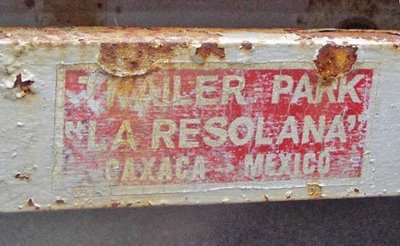
November 29, 2008
#49 - Michele Inspects the Progress
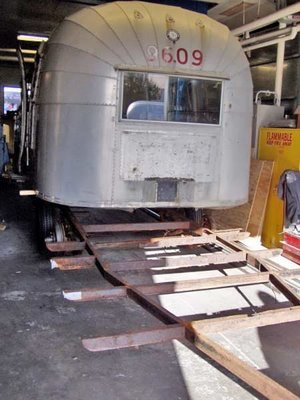
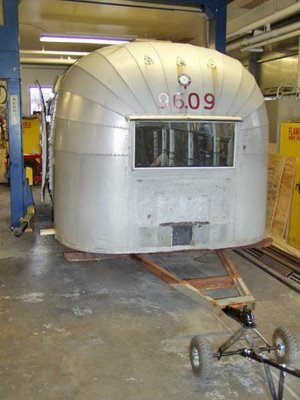
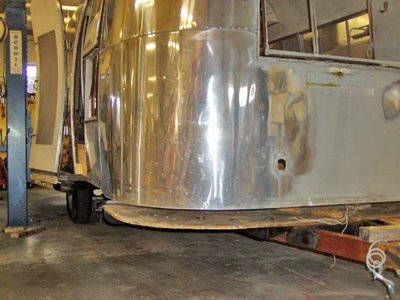
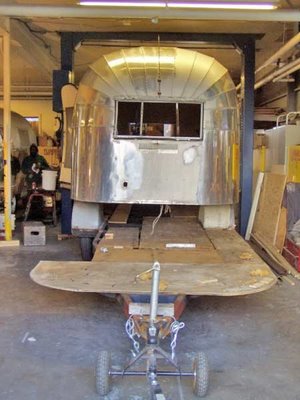
Michele and I took a trip to Plattsburgh Wednesday so she could see where the project sits and we could start to get serious about our floorplan. It was great that she finally got to see the trailer in person. This project has been going on a long time and this is her first look at it.

October 03, 2008
#48 - Window Frame Polishing
After a lot of trial and error, I've come up with an efficient process for removing the heavy oxidation and corrosion from the window frames and creating a near-mirror finish. My method isn't cheap. It requires an investment in consumable abrasives, pads and polishing compounds. I haven't added it up, but I know I've spent more than $200 in consumables just to polish the 9 windows' frames. That's in addition to an air compressor and an angle grinder. After trying it a few different ways, I'm convinced the best tool for the job is a pneumatic 1/4" right angle die grinder. Get a cheap one for under $30 on eBay.
Here are the steps on the aluminum frames:
1. You can waste a lot of time trying to get the heavy oxidation off your windows with the wrong tools, abrasives and polishes. You have to overcome your fear and be aggressive. This isn't the trailer's ALCLAD skin so you can use tools you'd never dream of using on the rest of the trailer.
Use 80 grit (yellow) 3M Bristle Discs in the 2" size on your grinder. Grind all surfaces that will be visible after installation. Bristle Discs are going to scratch the hell out of your frames. But they're fast and they get all the oxidation and corrosion off that you're going to get off. You might want to buy a few 1" bristle discs, too, for tight spots. Do NOT use the 3M radial bristle discs. They gouge.


2. After you've scratched all the severe oxidation and corrosion off, you need to fix the scratches. Get some 320 grit and 400 grit wet sandpapers and hand sand everything you just took the grinder to. You have to go over it a lot to get out all the swirls from the bristle discs. Don't hurry this step. Clean frequently. Make sure the swirls are gone. Now instead of swirls, you will be left with finer scratches going the length of the frames. The second photo below shows the "before and after" of the hand sanding.
3. From here on, you'll be back to the power tools. Place a cotton 1.5" cylindrical or goblet-shaped buff in your grinder. Use Nuvite F9 polish and slowly polish everything that has been sanded.
4. Use a different buff to do it again with Nuvite C polish.
5. At this point it looks pretty good. If you would like, do it again with Nuvite S and a third buff, but I'd recommend waiting until it is installed back in the trailer before worrying about Grade S.
A note about what to polish and what not to polish... While you want to get all the oxidation and corrosion off all the parts, some parts of the frame don't need to be polished through all 5 steps above. Obviously the exterior of the front frame should be a mirror. But the backs of the back frames will basically not show at all and can be left in a clean but unpolished state.
Here are the steps on the aluminum frames:
1. You can waste a lot of time trying to get the heavy oxidation off your windows with the wrong tools, abrasives and polishes. You have to overcome your fear and be aggressive. This isn't the trailer's ALCLAD skin so you can use tools you'd never dream of using on the rest of the trailer.
Use 80 grit (yellow) 3M Bristle Discs in the 2" size on your grinder. Grind all surfaces that will be visible after installation. Bristle Discs are going to scratch the hell out of your frames. But they're fast and they get all the oxidation and corrosion off that you're going to get off. You might want to buy a few 1" bristle discs, too, for tight spots. Do NOT use the 3M radial bristle discs. They gouge.
2. After you've scratched all the severe oxidation and corrosion off, you need to fix the scratches. Get some 320 grit and 400 grit wet sandpapers and hand sand everything you just took the grinder to. You have to go over it a lot to get out all the swirls from the bristle discs. Don't hurry this step. Clean frequently. Make sure the swirls are gone. Now instead of swirls, you will be left with finer scratches going the length of the frames. The second photo below shows the "before and after" of the hand sanding.
3. From here on, you'll be back to the power tools. Place a cotton 1.5" cylindrical or goblet-shaped buff in your grinder. Use Nuvite F9 polish and slowly polish everything that has been sanded.
4. Use a different buff to do it again with Nuvite C polish.
5. At this point it looks pretty good. If you would like, do it again with Nuvite S and a third buff, but I'd recommend waiting until it is installed back in the trailer before worrying about Grade S.
A note about what to polish and what not to polish... While you want to get all the oxidation and corrosion off all the parts, some parts of the frame don't need to be polished through all 5 steps above. Obviously the exterior of the front frame should be a mirror. But the backs of the back frames will basically not show at all and can be left in a clean but unpolished state.
October 01, 2008
#47 - Proper Window Restoration
To begin a window restoration, the window needs to be disassembled. Front frame and back frame are separated at the hinge. Then the vertical center channels are removed from the frames. Take care with the extruded aluminum front frame channels. The 4 rusty mild steel screws that hold them in place easily break off inside the channels.
After the channels are off, the old screen is removed from the back frame and the glass is removed from the front frame. To get the glass out, you'll be removing lots of little rusty fasteners that secure the L-shaped aluminum glass holders behind the glass. Throw the screws and nuts away. You can get new screws and tension nuts from Vintage Trailer Supply.
All the dismantling is necessary so you can de-rust and repaint the steel back frame channels. You're also going to replace the old screen material, get new glass, and then spend hours and hours removing corrosion and polishing the aluminum frames. The photo below shows a pile of back frames. The first two frames show what they look like when the oxidation and corrosion have been mostly removed (but before detailing). The rest show the extremely heavy oxidation and significant corrosion you'll encounter.

After the channels are off, the old screen is removed from the back frame and the glass is removed from the front frame. To get the glass out, you'll be removing lots of little rusty fasteners that secure the L-shaped aluminum glass holders behind the glass. Throw the screws and nuts away. You can get new screws and tension nuts from Vintage Trailer Supply.
All the dismantling is necessary so you can de-rust and repaint the steel back frame channels. You're also going to replace the old screen material, get new glass, and then spend hours and hours removing corrosion and polishing the aluminum frames. The photo below shows a pile of back frames. The first two frames show what they look like when the oxidation and corrosion have been mostly removed (but before detailing). The rest show the extremely heavy oxidation and significant corrosion you'll encounter.
If you've polished an Airstream, you know about oxidation. It's not quick to remove, but on a trailer skin it isn't really that big a deal because the oxidation is generally even and rather thin. You can read my article on polishing an Airstream if you don't know the basics.
Polishing 53-year old window frames is nothing like polishing an Airstream. Repeat: nothing. Rub your finger across the back frame's sill. Feel how rough that is?. That's extreme oxidation and corrosion. The oxidation builds up into little craggy mountains of oxide. It cannot be polished off with aluminum polish. Don't even try. You're going to be grinding it or sanding it off. After you get it off, you're going to see little pits and valleys in the aluminum. That's corrosion and you can't entirely fix it. You can minimize it by continuing to grind and sand, but some of it is going to be there when you're finished. Fortunately, the only place the corrosion will be especially noticeable after you reassemble everything is in that exterior sill area. And that's not visible when the windows are closed.
In my next post I'll detail how to remove the severe oxidation.
Polishing 53-year old window frames is nothing like polishing an Airstream. Repeat: nothing. Rub your finger across the back frame's sill. Feel how rough that is?. That's extreme oxidation and corrosion. The oxidation builds up into little craggy mountains of oxide. It cannot be polished off with aluminum polish. Don't even try. You're going to be grinding it or sanding it off. After you get it off, you're going to see little pits and valleys in the aluminum. That's corrosion and you can't entirely fix it. You can minimize it by continuing to grind and sand, but some of it is going to be there when you're finished. Fortunately, the only place the corrosion will be especially noticeable after you reassemble everything is in that exterior sill area. And that's not visible when the windows are closed.
In my next post I'll detail how to remove the severe oxidation.
September 21, 2008
#46 - Back in the Saddle
My daughter is now 17 months old. My excuse has grown old.
With a wet New England winter approaching (again), my trailer must have its windows soon. The plastic sheets taped over the rough openings in the trailer are tattered. They won't last another winter.
Inspired by cold weather, I retrieved the large box of windows in my basement where I stashed them nearly two years ago.

There are 6 large windows (4 make up the Caravanner's trademark "Panoram" on the street side) and 3 smaller windows on the curb side. All 9 windows are Hehr Standard windows with gear type operators, as was the norm on 1956 Airstreams.
Hehr (brand name) Standard (model name) windows were the most commonly used windows in the vintage trailer world for all types of trailers built in the 1950s and well into the 1960s. They were used on Airstreams starting in 1952 and used as late as 1960 on a few models. They were used by canned ham trailer makers throughout the 1960s. They are now obsolete and the only parts available are those we've had reproduced.
Hehr Standard windows are awning style windows with a hinge on top. They have two primary parts: the front frame and the back frame. The front frame is the part that swings and holds the glass. The back frame is the part that is stationary and mounted in the wall of the trailer. It holds the insect screen.
After 50 years of neglect, my windows were in desperate need of restoration. Rusty steel fasteners, latches, operators and channels all needed replacing or de-rusting. The aluminum was, at best, heavily oxidized. At worst, it was heavily corroded. The glass was scratched. The vinyl rubber gaskets dried and shrunk. The galvanized steel insect screen was heavily corroded to the point of reducing visibility.
The only way to restore a Standard window correctly is to remove it entirely from the trailer body. That's because you have to do a lot of work to the back frame...including replacing the back frame gasket that is mounted by slipping part of the gasket between the back frame and the trailer skin with the rivets holding the back frame to the trailer going through the gasket! (There's an early 1950s variation on the window that is mounted slightly differently.)
In subsequent posts, I'll talk in detail about how to properly and completely restore the back frames and the front frames.
With a wet New England winter approaching (again), my trailer must have its windows soon. The plastic sheets taped over the rough openings in the trailer are tattered. They won't last another winter.
Inspired by cold weather, I retrieved the large box of windows in my basement where I stashed them nearly two years ago.
There are 6 large windows (4 make up the Caravanner's trademark "Panoram" on the street side) and 3 smaller windows on the curb side. All 9 windows are Hehr Standard windows with gear type operators, as was the norm on 1956 Airstreams.
Hehr (brand name) Standard (model name) windows were the most commonly used windows in the vintage trailer world for all types of trailers built in the 1950s and well into the 1960s. They were used on Airstreams starting in 1952 and used as late as 1960 on a few models. They were used by canned ham trailer makers throughout the 1960s. They are now obsolete and the only parts available are those we've had reproduced.
Hehr Standard windows are awning style windows with a hinge on top. They have two primary parts: the front frame and the back frame. The front frame is the part that swings and holds the glass. The back frame is the part that is stationary and mounted in the wall of the trailer. It holds the insect screen.
After 50 years of neglect, my windows were in desperate need of restoration. Rusty steel fasteners, latches, operators and channels all needed replacing or de-rusting. The aluminum was, at best, heavily oxidized. At worst, it was heavily corroded. The glass was scratched. The vinyl rubber gaskets dried and shrunk. The galvanized steel insect screen was heavily corroded to the point of reducing visibility.
The only way to restore a Standard window correctly is to remove it entirely from the trailer body. That's because you have to do a lot of work to the back frame...including replacing the back frame gasket that is mounted by slipping part of the gasket between the back frame and the trailer skin with the rivets holding the back frame to the trailer going through the gasket! (There's an early 1950s variation on the window that is mounted slightly differently.)
In subsequent posts, I'll talk in detail about how to properly and completely restore the back frames and the front frames.
November 11, 2007
#45 - Why Aistream Restorations Are So Slow
I've noticed that many, many Airstream restorations stretch on for years. For most people, a lack of money and time are the two biggest culprits. Here's my excuse.

Click on her picture and you'll see my point. Her name is Sadie and she's now 7 months old. You'll notice my last post is about the same age.
I'm supposed to be polishing window frames so they can be reinstalled in the rough openings in my trailer walls. It's hard to justify time in a garage with an air compressor when I can be bouncing Sadie on my knee. But I'm motivated by camping next summer with my wife Michele and Sadie, so I expect to get back in the saddle soon.
Click on her picture and you'll see my point. Her name is Sadie and she's now 7 months old. You'll notice my last post is about the same age.
I'm supposed to be polishing window frames so they can be reinstalled in the rough openings in my trailer walls. It's hard to justify time in a garage with an air compressor when I can be bouncing Sadie on my knee. But I'm motivated by camping next summer with my wife Michele and Sadie, so I expect to get back in the saddle soon.
May 19, 2007
#44 - How to Make an Astradome
With new Fan-Tastic fans installed in 2 out of 3 of my 14" roof vents, I decided to get creative with the third opening.
Starting in either 1957 or 1958, Airstream offered an extra large unpowered roof vent called an "Astradome." It was the standard 14" wide, but 25" long. It's a neat 50s Airstream feature that I decided to add to my trailer.

The hardware is all the same as a standard 14" square opening, so all I needed to do was stretch the opening and mount a reproduction lid. The only thing left undone is to make a long screen for it.

Now my living room area will have a large opening in the ceiling and my galley and rear bedroom will have powered fans.
Starting in either 1957 or 1958, Airstream offered an extra large unpowered roof vent called an "Astradome." It was the standard 14" wide, but 25" long. It's a neat 50s Airstream feature that I decided to add to my trailer.

The hardware is all the same as a standard 14" square opening, so all I needed to do was stretch the opening and mount a reproduction lid. The only thing left undone is to make a long screen for it.

Now my living room area will have a large opening in the ceiling and my galley and rear bedroom will have powered fans.
April 11, 2007
#43 - New Roof Vents
My Caravanner has 3 roof vents. Originally, all three were standard 14"x14" aluminum Hehr vents. They were in poor condition, with missing and seized cranks and dented and missing lids. The first photo shows a giant Tupperware lid being used as a temporary lid on one of them.
Between my two trailers and parts I've accumulated on eBay and elsewhere, I have plenty of good spare parts to make all 3 open and close almost like new again...the only problem was the old fans in them. Even if I could get those working, the old Hehr aluminum blade fans were just too noisy and inefficient.
I decided that I would like to have 2 of the 3 vents outfitted with modern powered fans. By far, the best powered fans on the market today are made by Fan-Tastic Vent. Recently, my company Vintage Trailer Supply started selling gray Fantastic units with gray flat lids. I worked with Fantastic to develop this special style unit specifically for vintage Airstreams. To demonstrate how great they look on vintage trailers, I put them in the rear two locations on my trailer.
Between my two trailers and parts I've accumulated on eBay and elsewhere, I have plenty of good spare parts to make all 3 open and close almost like new again...the only problem was the old fans in them. Even if I could get those working, the old Hehr aluminum blade fans were just too noisy and inefficient.
I decided that I would like to have 2 of the 3 vents outfitted with modern powered fans. By far, the best powered fans on the market today are made by Fan-Tastic Vent. Recently, my company Vintage Trailer Supply started selling gray Fantastic units with gray flat lids. I worked with Fantastic to develop this special style unit specifically for vintage Airstreams. To demonstrate how great they look on vintage trailers, I put them in the rear two locations on my trailer.
March 21, 2007
#42 - Scary Old Wiring
Once the insulation is out, we really got a good look at the ratty old wiring circa 1956. Instead of using boxes at junctions and around outlets, they simply wrapped wire connections with electrical tape. The black stuff on the aluminum is seam and rivet sealant. The masking tape was used to hold the wiring in place. The writings in black Sharpie are new notes to remember where everything goes.
#41 - Removing the Remaining Interior
Chris is removing the remaining inside walls by simply drilling out the rivets. The bottom wall segments were removed earlier so the shell could be attached to the floor, but we waited on the upper segments to give the shell structural stability until after the shell was firmly attached to the floor.
March 05, 2007
January 09, 2007
#39 - I Want A Rear Hatch
The photo below shows the rear panel on my #2 shell (the good shell) all taped up for the winter with aluminum foil tape. You can see that the panel below the window is just a plain panel with no storage compartment access door. With a rear bedroom trailer, a rear storage compartment seems like a must-have to get access to all that great storage space. You will also notice there's a round vent in the panel. That vent may have been for the bathroom, but it is no longer necessary.

The next photo shows the rear panel on my #1 shell (the junker shell). The panel is in great condition and even has a hatch with a good door and drip cap. The rusty handle is bad, but that part is on my list of parts to find and add to the inventory at Vintage Trailer Supply.

Are you thinking what I'm thinking? Apparently Santo is. What an easy way to add a hatch. Just a few rivets and it will be finished. Gotta love having a parts trailer! (I know Santo looks miffed, but that's just because Colin is taking his photo and micro-managing him at the same time!)

The demise of the #1 shell continues, but now I'll have a rear hatch and a perfectly good panel on my trailer!

Here's the hatch being installed on my good shell. The framing in the wall will need to be modified to fit the opening. Notice that using buck rivets is a two-person job, with one person inside holding the bucking bar behind each rivet as it is installed. If the inside wall was already in place, buck rivets couldn't be used. That's why Olympic shave head blind rivets were invented.

The next photo shows the rear panel on my #1 shell (the junker shell). The panel is in great condition and even has a hatch with a good door and drip cap. The rusty handle is bad, but that part is on my list of parts to find and add to the inventory at Vintage Trailer Supply.

Are you thinking what I'm thinking? Apparently Santo is. What an easy way to add a hatch. Just a few rivets and it will be finished. Gotta love having a parts trailer! (I know Santo looks miffed, but that's just because Colin is taking his photo and micro-managing him at the same time!)

The demise of the #1 shell continues, but now I'll have a rear hatch and a perfectly good panel on my trailer!

Here's the hatch being installed on my good shell. The framing in the wall will need to be modified to fit the opening. Notice that using buck rivets is a two-person job, with one person inside holding the bucking bar behind each rivet as it is installed. If the inside wall was already in place, buck rivets couldn't be used. That's why Olympic shave head blind rivets were invented.
December 23, 2006
#38 - Pardon the Interruption
I'm too busy right now to do much on my Caravanner project. Big changes are happening at my company, Vintage Trailer Supply. In January, we're moving to a new facility, dramatically upgrading our technology (again), adding even more new items, and then hiring more help. Although I'm excited to grow and improve customer service for our super-loyal customers, the investments keep money and time very tight.
In January, I hope to spend many hours polishing and rebuilding all my window frames. All the windows have been removed from the trailer. They were riveted in at the factory, so all the rivets--hundreds of them--had to be drilled out. The trailer is left with rough openings where the windows were. They're covered with plastic for the winter. The windows are in my basement waiting for me to get to work.
December 06, 2006
#37 - Finishing the Floor
Today's project was to finish installing the floor and then securely attach the shell to the floor.
For an Airstream to be structurally sound, the floor must be solid. But I'm not talking about the part of the floor you walk on. I'm talking about the part of the floor under the walls.
When an Airstream is built, the plywood is installed first and the shell is put on top. So when the plywood around the edges softens and disintegrates, it leaves a 5/8" gap between the bottom of the wall and the top of the chassis! To make matters worse, Wally's crews usually screwed the bottom of the wall into the plywood, but not all the way through the plywood and then into the chassis. So if your floor is soft under the walls, you have NOTHING holding the shell to the chassis in the area of the weak floor!
The shell must be bolted or screwed through solid floor and into the chassis. That's why floor repair is so hard on an Airstream...and is so often done insufficiently. Floor repair shortcuts that put new pieces of floor up to the wall, but not under it, may give you a firm floor, but they will not fix the underlying problem of a shell and chassis that are not fully secured.

Before the plywood and chassis are fastened securely together, the chassis will have a tendency to sag at the rear end. Working on a solid level surface and using temporary jacks to hold everything straight is essential until the floor is fully fastened down. Notice, also, the extra long chassis rails. Caravanner #1 came with a 1960s-style trunk bumper for the sewer hose rather than a simple 1950s bumper. I'm going to replicate that feature.

The photo above shows the new plywood floor spanning the restored chassis. For extra stability, construction adhesive is used where the floor touches the chassis. Back in the day, Wally's crews layed fiberglass insulation across the chassis before the plywood was layed. We aren't doing it that way. We'll be insulating from below before the belly pan is closed up.

Notice the odd plywood seam pattern above. The edges of each piece of plywood need to all end up on frame members so they are supported. My chassis is modified to create a trapezoidal spare tire storage area under the floor. You can see it in post #25. This is also a good shot of how all plywood edges (and all undersides) are treated with wood preservative.

The fasteners of choice for the floor are elevator bolts and countersunk self-tapping machine screws. The elevator bolts are great because their wide flat heads are easy to countersink and could never pull through the plywood. They're secured with a hex nut underneath. The special self-tapping machine screws are almost as good. They have threads like bolts. They're used only where it would be impossible to reach the bottom end of a bolt to put on a hex nut. With the screws, the frame member is tapped so it acts like a nut and holds great. In a case like his, they aren't used much. But if you are doing a floor repair without removing the belly pan, they're your best friend.

The shell has a U-channel inside the bottom edge of the wall all the way around. It's what secures the bottoms of the inner and outer skins of the trailer. Remove the lower segments of inner skin to get access to the U-channel. Screws and bolts are used to hold the U-channel to the floor and chassis. Here you can see the nuts on the ends of elevator bolts that were inserted through outriggers from below and then up through the channel. Sometimes, they go the other way. It doesn't much matter what fasteners you use here since they are hidden, but they should hold tight to the chassis as much as possible.
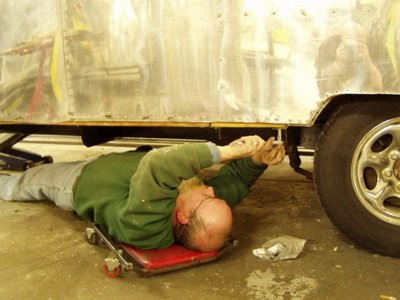
It can be tricky to get the nut on the bolt underneath. It's a two-person job. Above, Joe holds the socket wrench while Chris is working the top side.
For an Airstream to be structurally sound, the floor must be solid. But I'm not talking about the part of the floor you walk on. I'm talking about the part of the floor under the walls.
When an Airstream is built, the plywood is installed first and the shell is put on top. So when the plywood around the edges softens and disintegrates, it leaves a 5/8" gap between the bottom of the wall and the top of the chassis! To make matters worse, Wally's crews usually screwed the bottom of the wall into the plywood, but not all the way through the plywood and then into the chassis. So if your floor is soft under the walls, you have NOTHING holding the shell to the chassis in the area of the weak floor!
The shell must be bolted or screwed through solid floor and into the chassis. That's why floor repair is so hard on an Airstream...and is so often done insufficiently. Floor repair shortcuts that put new pieces of floor up to the wall, but not under it, may give you a firm floor, but they will not fix the underlying problem of a shell and chassis that are not fully secured.

Before the plywood and chassis are fastened securely together, the chassis will have a tendency to sag at the rear end. Working on a solid level surface and using temporary jacks to hold everything straight is essential until the floor is fully fastened down. Notice, also, the extra long chassis rails. Caravanner #1 came with a 1960s-style trunk bumper for the sewer hose rather than a simple 1950s bumper. I'm going to replicate that feature.
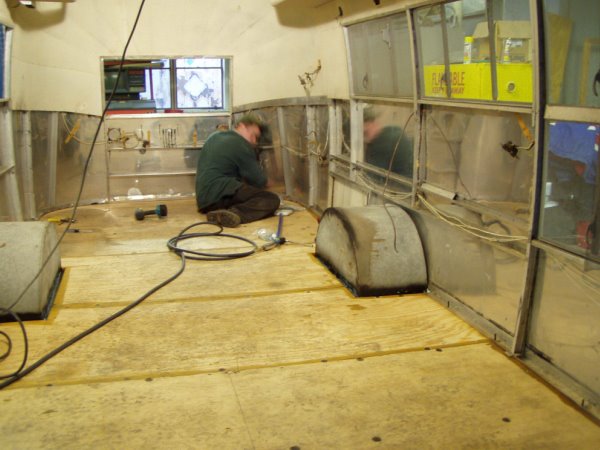
The photo above shows the new plywood floor spanning the restored chassis. For extra stability, construction adhesive is used where the floor touches the chassis. Back in the day, Wally's crews layed fiberglass insulation across the chassis before the plywood was layed. We aren't doing it that way. We'll be insulating from below before the belly pan is closed up.

Notice the odd plywood seam pattern above. The edges of each piece of plywood need to all end up on frame members so they are supported. My chassis is modified to create a trapezoidal spare tire storage area under the floor. You can see it in post #25. This is also a good shot of how all plywood edges (and all undersides) are treated with wood preservative.
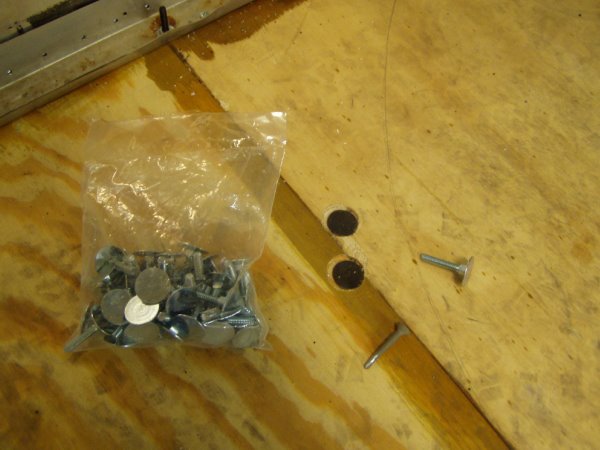
The fasteners of choice for the floor are elevator bolts and countersunk self-tapping machine screws. The elevator bolts are great because their wide flat heads are easy to countersink and could never pull through the plywood. They're secured with a hex nut underneath. The special self-tapping machine screws are almost as good. They have threads like bolts. They're used only where it would be impossible to reach the bottom end of a bolt to put on a hex nut. With the screws, the frame member is tapped so it acts like a nut and holds great. In a case like his, they aren't used much. But if you are doing a floor repair without removing the belly pan, they're your best friend.
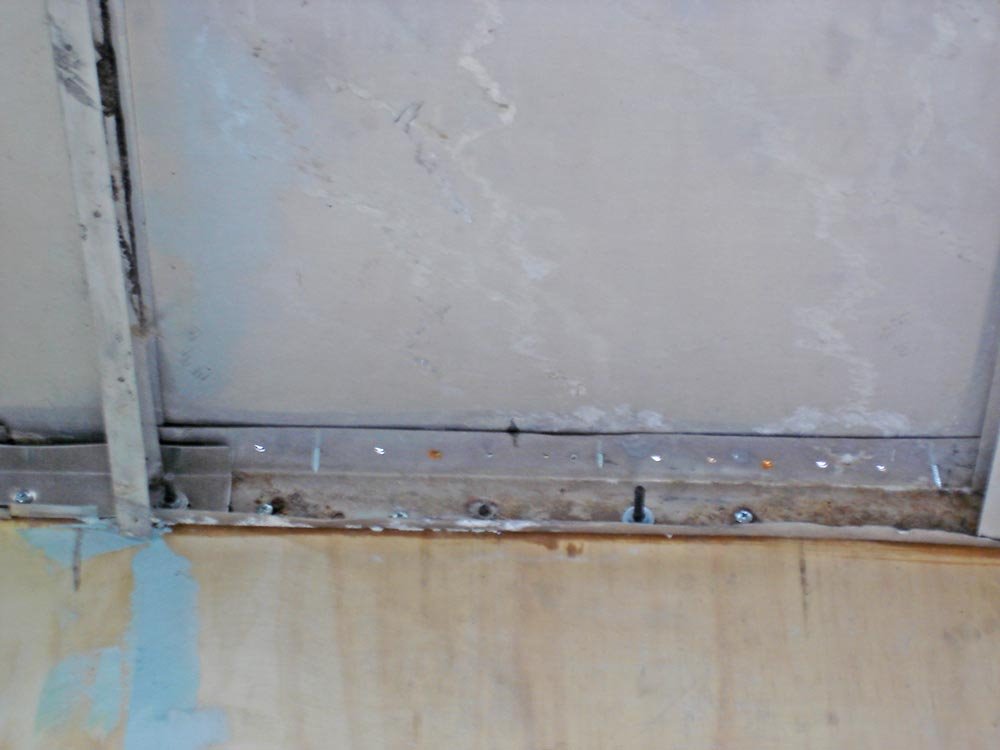
The shell has a U-channel inside the bottom edge of the wall all the way around. It's what secures the bottoms of the inner and outer skins of the trailer. Remove the lower segments of inner skin to get access to the U-channel. Screws and bolts are used to hold the U-channel to the floor and chassis. Here you can see the nuts on the ends of elevator bolts that were inserted through outriggers from below and then up through the channel. Sometimes, they go the other way. It doesn't much matter what fasteners you use here since they are hidden, but they should hold tight to the chassis as much as possible.

It can be tricky to get the nut on the bolt underneath. It's a two-person job. Above, Joe holds the socket wrench while Chris is working the top side.
December 04, 2006
#36 - Swapping Shells
Here's something you'll probably never see again: Today, Colin's crew swapped the shells and chassis from two identical vintage Airstreams.
The ordeal was necessary because my #1 1956 Caravanner has a beautifully restored and customized chassis and my #2 1956 Caravanner has a much better shell. By marrying the #1 chassis and #2 shell, we'll get the best of both trailers. The photos below will show the general steps they followed.
First, Caravanner #1 was brought inside the shop...
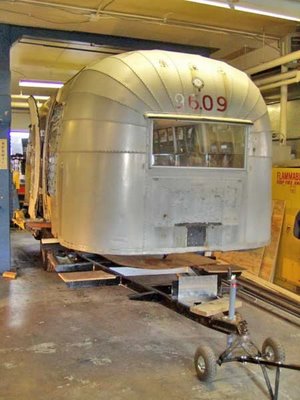
The shell of #1 is separated from its chassis and lifted high enough to clear the wheel wells.
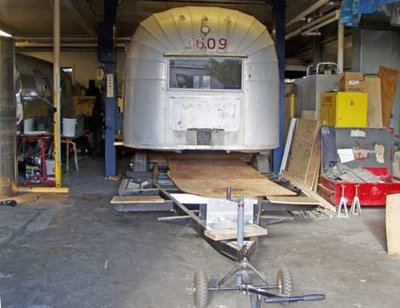
The good #1 chassis is pulled out from under its shell and set aside for the time being.
Next, a spare old rusty chassis is pushed underneath. This one just happens to have belonged to movie star Matthew McConaughey. Colin's crew is working on Matthew's trailer simultaneously, and they built him a brand new chassis rather than restoring his original.
Shell #1 is set down on Matthew's old chassis and minimally fastened so it doesn't fall off. They will be towed off to the back part of the lot where they will be used for parts for my trailer and others.
Now Caravanner #2 is brought inside...
The #2 shell and chassis are separated.
With the shell up in the air, the #2 chassis is pulled out from underneath. That #2 chassis is set aside for now. I will try to find a loving home for it since it is in restorable condition.
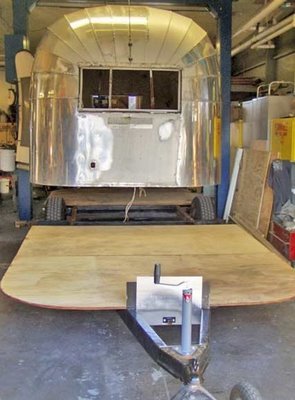
Here, my restored chassis from #1 is brought back in the shop and pushed underneath the #2 shell.
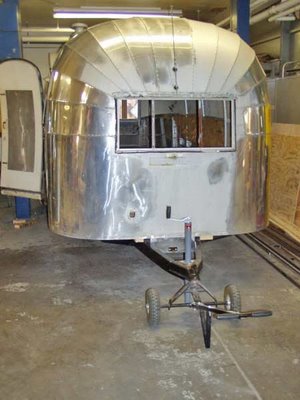
Finally, the #2 shell is carefully lowered down on the #1 chassis. Fortunately, it fits! With each 50s Airstreams being somewhat unique in construction, we couldn't be 100% sure until the moment of completion.
The next step will be to finish installing the plywood floor and then secure the #2 shell to it's "new" chassis.
The ordeal was necessary because my #1 1956 Caravanner has a beautifully restored and customized chassis and my #2 1956 Caravanner has a much better shell. By marrying the #1 chassis and #2 shell, we'll get the best of both trailers. The photos below will show the general steps they followed.
First, Caravanner #1 was brought inside the shop...
The shell of #1 is separated from its chassis and lifted high enough to clear the wheel wells.
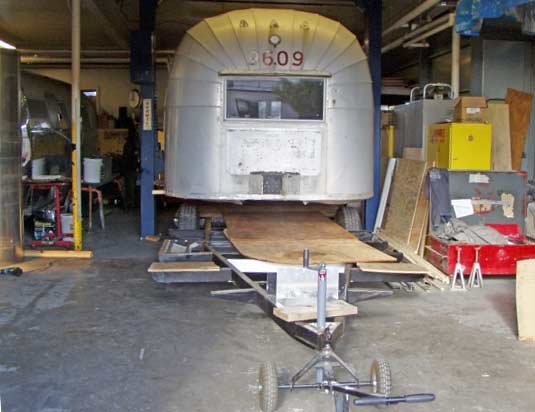
The good #1 chassis is pulled out from under its shell and set aside for the time being.
Next, a spare old rusty chassis is pushed underneath. This one just happens to have belonged to movie star Matthew McConaughey. Colin's crew is working on Matthew's trailer simultaneously, and they built him a brand new chassis rather than restoring his original.
Shell #1 is set down on Matthew's old chassis and minimally fastened so it doesn't fall off. They will be towed off to the back part of the lot where they will be used for parts for my trailer and others.Now Caravanner #2 is brought inside...
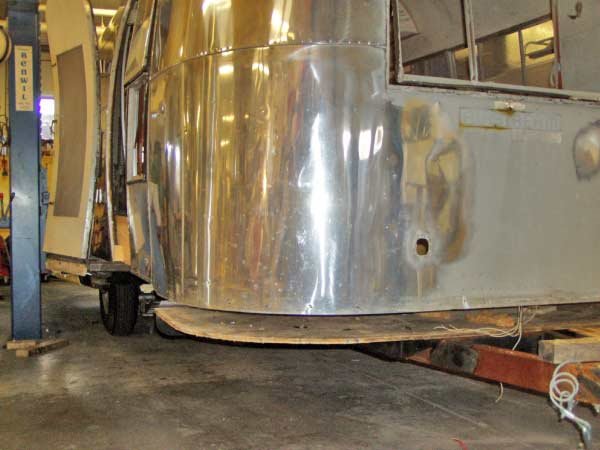
The #2 shell and chassis are separated.
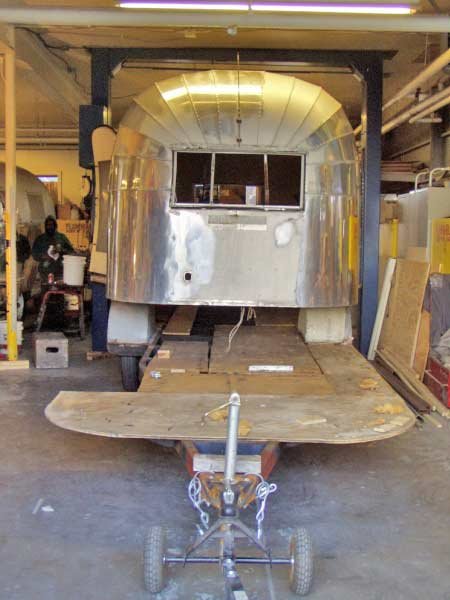
With the shell up in the air, the #2 chassis is pulled out from underneath. That #2 chassis is set aside for now. I will try to find a loving home for it since it is in restorable condition.
Here, my restored chassis from #1 is brought back in the shop and pushed underneath the #2 shell.
Finally, the #2 shell is carefully lowered down on the #1 chassis. Fortunately, it fits! With each 50s Airstreams being somewhat unique in construction, we couldn't be 100% sure until the moment of completion.The next step will be to finish installing the plywood floor and then secure the #2 shell to it's "new" chassis.
December 03, 2006
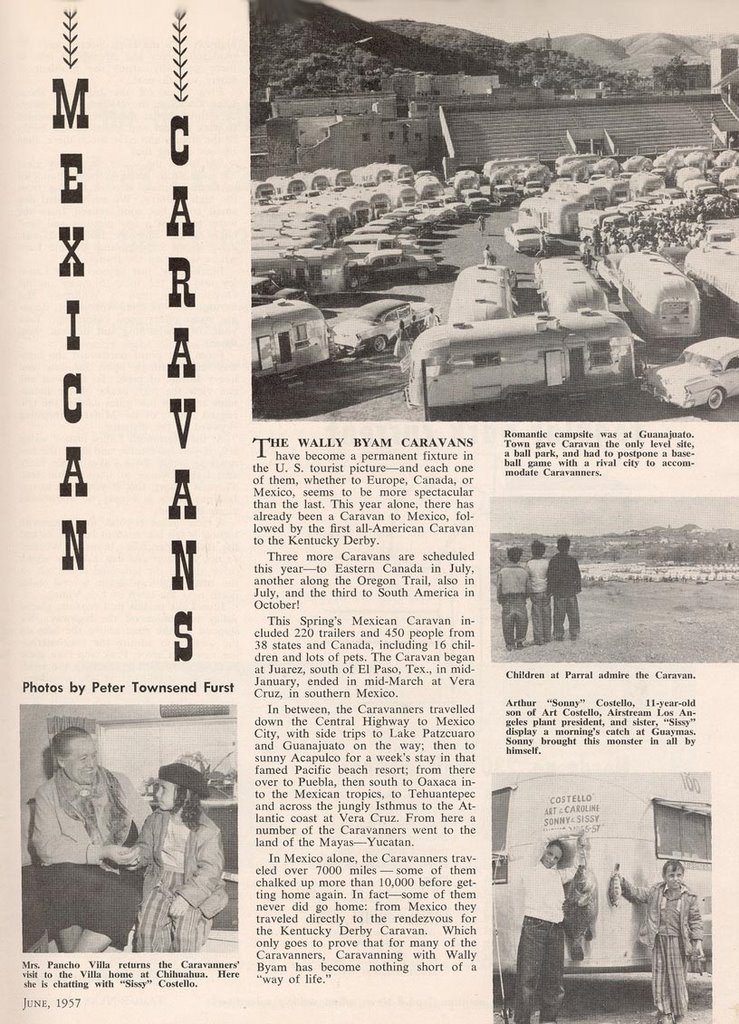
#35 - Mexican Caravan
December 01, 2006
#34 - Wally Byam's Style
Vintage Airstream owners keep Wally Byam's legacy alive. But what is it that matters about Wally, now decades after his death? Someday, I'd like to read or write a good biography of Wally. Perhaps we know less than half the story.
No matter who Wally really was, we do know he was a master at public relations and marketing. He reminds me a little of Richard Branson of Virgin Inc. Like Sir Richard, Wally used his personality and his own lifestyle to promote his products and create a buzz and cool-factor that translated into sales of his travel trailers. But even more than an ingenious marketer, Wally seems to have been authentically committed to promoting a life of travel and adventure for all Americans. In his books, he pushes his readers to get out of the rocking chair and travel.
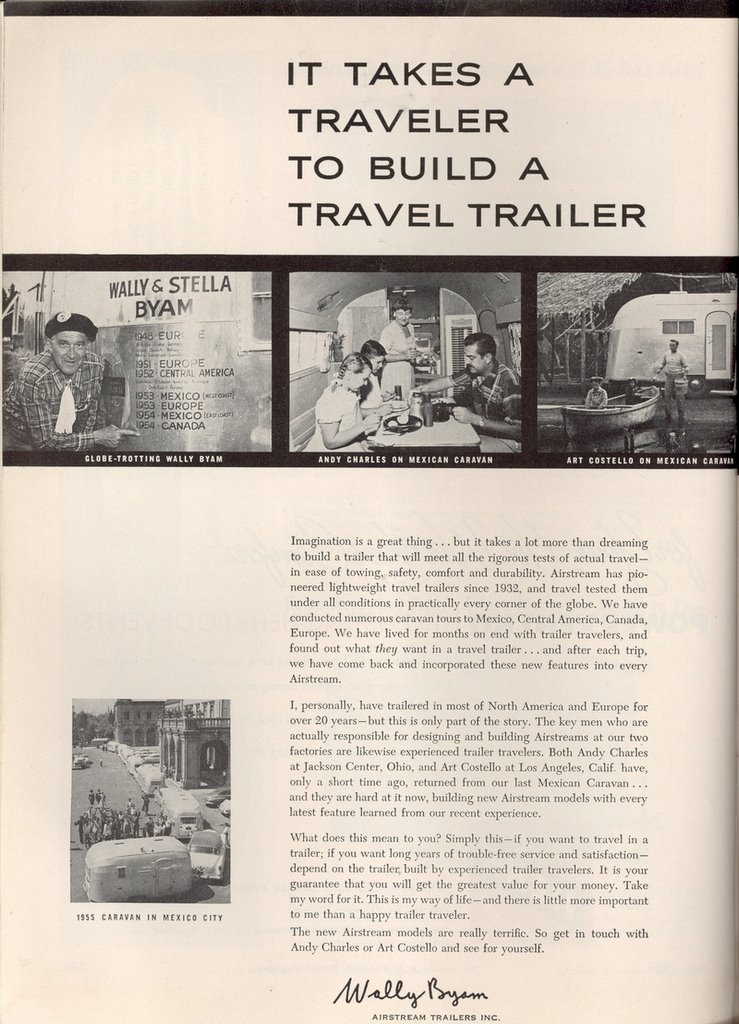
Here's a great ad from right around 1956 that demonstrates the way he wove together marketing and adventure. You might have to click on it more than once to make it the big enough to read.
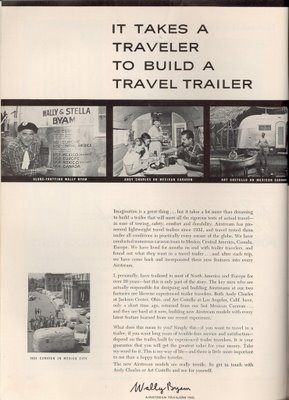
No matter who Wally really was, we do know he was a master at public relations and marketing. He reminds me a little of Richard Branson of Virgin Inc. Like Sir Richard, Wally used his personality and his own lifestyle to promote his products and create a buzz and cool-factor that translated into sales of his travel trailers. But even more than an ingenious marketer, Wally seems to have been authentically committed to promoting a life of travel and adventure for all Americans. In his books, he pushes his readers to get out of the rocking chair and travel.
Here's a great ad from right around 1956 that demonstrates the way he wove together marketing and adventure. You might have to click on it more than once to make it the big enough to read.
November 22, 2006
#33 - 1956 Original Features
I found a 1957 Caravanner brochure on the VAC site. I haven't found a 1956 Caravanner brochure, but the two models were similar. If anyone finds a '56 brochure, let me know.
Here's the most humorous section of the sales pitch for this trailer. Remember the shell is only 19' long:
"Bold, adventurous trailering awaits the young at heart in this excitingly new lightweight Airstream crusing model."Here are the standard features of the Caravanner. At this point, I'm planning to modify or remove features in red:
- Overall length - 22'
- Body length - 19'
- Overall weight - 2800 lbs.
- Hitch weight - 270 lbs.
- Choice of 3 interior wall colors.
- Comfortable divan with arms, converts to double bed. (I'm doing a dinette in front that converts to a bed.)
- 48" x 76" Airloom double bed. (I'm 78" tall.)
- Marine type flushing toilet, shower and vanity type lavatory.
- Electric water heater. (I'm going with gas.)
- Five foot drop-leaf table. (Our dinette will serve this purpose.)
- Butane radiant heater.
- Combination 5.8 cu ft ice-electric refrigerator with freezer. (The trailer came with the gas option below.)
- Double basin sink with swing faucet.
- Butane range, 3-burner, oven, broiler.
- 60" of Formica galley tops in kitchen.
- 116" of roof lockers, 32" wardrobe.
- Closet for household appliances.
- One 6 or 12 volt battery dome light. (I'll add a few.)
- Airstream's "Airliner" curtains. (I don't know what these looked like. Maybe I can recreate them.)
- Linoleum tiled floors. (Real Linoleum sheet instead of tiles.)
- 9 crank operated windows.
- 3 roof vents, power fan in center vent.
- Warp-proof hollow core cabinet doors.
- Touch control built-in step.
- Radio antenna
- Butane tank
- Imported "Sta-Closed" closet catches.
- Porch light.
- 12' awning rail.
- Waterproof 110 volt electrical outlet.
- Escape type rear window.
- Fiberglass insulation.
- Trunk compartment.
- Steel bumper.
- Shock absorbers.
- Electric brakes.
- Truck wheels 7.00x15 six-ply tires.
- Pressurized water system.
- 3.9 cu ft gas refrigerator.
- Septic tank for toilet.
- Gas water heater.
- Puncture proof tubes. (I'll be using tubeless.)
- 8-ply tires.
- Two butane tanks.
"...an extra roomy shower, a unique concealed wash bowl that converts into an attractive mirrored vanity and a hot water heater."If you've ever seen the convertible vanity, you'll agree it's very slick.
Here's the most humorous section of the sales pitch for this trailer. Remember the shell is only 19' long:
"This wide open, spacious one room trailer is transformed into a two room apartment by simple use of an ingenious folding door. This also provides privacy for bedroom, toilet, lavatory and shower in their rear locations while the front living room is in use."It then mentions my absolute favorite part of Caravanners:
"The 20 sq ft of area in the giant 'Panoram' window presents a kaleidoscopic view of all of outdoors, while flooding the living room with daylight and ventilation."
November 19, 2006
#32 - The Damn Step
The RV step is a deceptively complicated object. Besides tread style, and width, depth and drop dimensions, steps vary based on the way they latch closed and the way they mount. For instance, vintage Airstream steps use cut outs in the outriggers as tracks. Newer versions come with their own tracks on the sides.
#1 didn't come with an original step. It was an older replacement model. Colin and I have been arguing about that damn step since I bought #1. He pushed me to look for an original. I said I didn't care how it looked and a new one is cheap...a lot cheaper than having him fabricate something. I have to be cost-conscious someplace and a non-original step seems like a good place.
But Colin is a perfectionist and he had installed enough old and new steps to argue that a properly restored vintage Airstream step not only looks unique but also works better than a new replacement.
Ultimately, the argument ended when my #2 Caravanner showed up with a good original step. It has been cut out of #2 and made to fit just like it should on the #1 chassis. Colin wins.
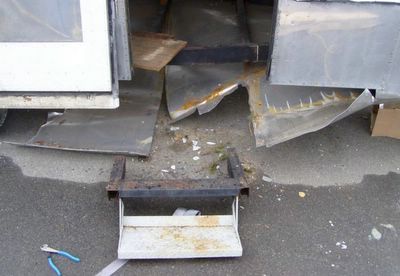
Original Step Cut from #2
Step from #2 Restored and Installed on #1.
#1 didn't come with an original step. It was an older replacement model. Colin and I have been arguing about that damn step since I bought #1. He pushed me to look for an original. I said I didn't care how it looked and a new one is cheap...a lot cheaper than having him fabricate something. I have to be cost-conscious someplace and a non-original step seems like a good place.
But Colin is a perfectionist and he had installed enough old and new steps to argue that a properly restored vintage Airstream step not only looks unique but also works better than a new replacement.
Ultimately, the argument ended when my #2 Caravanner showed up with a good original step. It has been cut out of #2 and made to fit just like it should on the #1 chassis. Colin wins.

Original Step Cut from #2
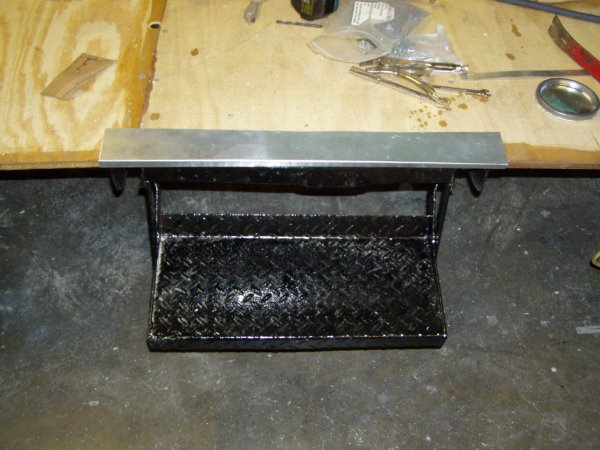
Step from #2 Restored and Installed on #1.
November 10, 2006
#31 - A Gold Mine!
As I had hoped, inside #2 is a gold mine of parts. Until now, I didn't know for sure because the previous owner had gutted the interior while they started the renovation. They threw it all back in loose when we picked it up. They promised it would be nearly complete, but I didn't believe it until it all came pouring out on the pavement when we got it back.
Inside were great original appliances, most of the original cabinets (stripped and sanded but not refinished), nearly all the window parts, original hubcaps, and more.
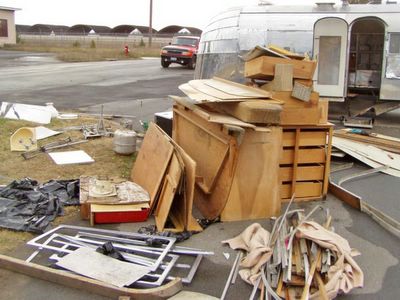
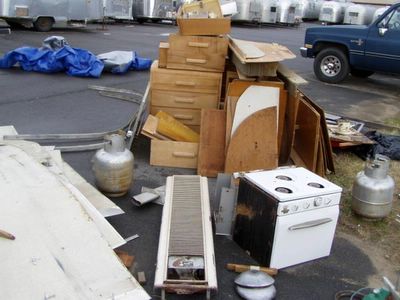
The propane fridge in the photo below is my favorite thing in the whole batch. It's an early Dometic gas-only fridge. The standard fridge in 1956 would have been a 110vac-only Marvel. Marvels are great looking fridges, but you have your fridge only when you are plugged in. Modern fridges go both ways, but they require a constant parasitic 12vdc draw on your battery to power the controls.
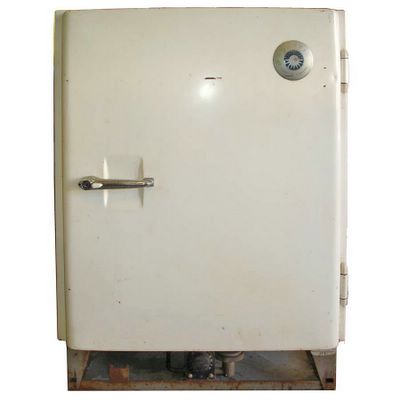
A Rare Original 1956 Dometic
Inside were great original appliances, most of the original cabinets (stripped and sanded but not refinished), nearly all the window parts, original hubcaps, and more.


The propane fridge in the photo below is my favorite thing in the whole batch. It's an early Dometic gas-only fridge. The standard fridge in 1956 would have been a 110vac-only Marvel. Marvels are great looking fridges, but you have your fridge only when you are plugged in. Modern fridges go both ways, but they require a constant parasitic 12vdc draw on your battery to power the controls.

A Rare Original 1956 Dometic
November 05, 2006
#30 - Are There "Restoration Ethics?"
For the record, the serial number for #1 is O-9003 and #2 is O-9045. I have great reverence for the history of vintage trailers. I see each of these as unique historic artifacts with stories to tell.
I'm always sad to see vintage trailers parted out. Every day in my job I talk to restorers who are looking for windows, doors, vents and other items that are simply not available anymore. As our hobby has grown, the overall value (not just $$ value) of an original exterior has gone way up. As our hobby continues to mature, the value of an original interior will become greater, too. I take all this very seriously--to the point of an ethical duty--while undertaking this restoration.
Less than 100 Caravanners were built in 1956, the first year Caravanners were made. It is somewhat wrong to reduce the surviving examples by 1. But there is so little left of my #1 that it wouldn't have been all that original when it was done, anyway. I have to think of it as saving one gorgeous example and using the spare parts to save a few others...like an organ donor.
Once the shell swap is finished, I'll need to rename them... referring to them as #1 and #2, or by their serial numbers will be confusing. Which trailer gets which serial number? I have already registered O-9003 and it is the one listed with the WBCCI... but doesn't the serial number stay with the shell?
I'm always sad to see vintage trailers parted out. Every day in my job I talk to restorers who are looking for windows, doors, vents and other items that are simply not available anymore. As our hobby has grown, the overall value (not just $$ value) of an original exterior has gone way up. As our hobby continues to mature, the value of an original interior will become greater, too. I take all this very seriously--to the point of an ethical duty--while undertaking this restoration.
Less than 100 Caravanners were built in 1956, the first year Caravanners were made. It is somewhat wrong to reduce the surviving examples by 1. But there is so little left of my #1 that it wouldn't have been all that original when it was done, anyway. I have to think of it as saving one gorgeous example and using the spare parts to save a few others...like an organ donor.
Once the shell swap is finished, I'll need to rename them... referring to them as #1 and #2, or by their serial numbers will be confusing. Which trailer gets which serial number? I have already registered O-9003 and it is the one listed with the WBCCI... but doesn't the serial number stay with the shell?
October 31, 2006
#29 - The Second Airstream Changes Everything
Yesterday, Rob Baker and Dick Perkins towed my #2 trailer from Rob's house to Colin's shop. Thanks guys.
I got my first real look at my second 1956 Caravanner and am impressed. The tree damage was minimal. The front 14x14 roof vent was damaged where a branch went down through it. And there are a few very mild dents in the front end cap on the curb side to the right of the door. I own a bunch of extra vents and Colin says he can fix the dents in the end cap so that they are unnoticeable.

Click the Photo to See How Mild the Dent Is
Overall, the shell is nearly perfect. It's partially polished here and there, so I didn't really notice finer scratches, but there are no dents at all other than the little ones Colin will remove.

Don't Mind the Missing Windows. They're Inside.
Seeing that near perfect shell on #2 made it absolutely clear where I'm going with this project. I'm taking shell #2 as a whole and moving it to chassis #1. Chassis #1 has been fixed and modified by Colin and his guys to add space for a spare tire, a gray tank and mounting plates for a torsion axle. With shell #2 on top, it's going to be a beautiful and structurally strong trailer.
Chassis #2 and shell #1 will be tacked together temporarily to form an organ donor trailer. Shell #1 has so many problems that it would cost way more to fix it than it will to fix shell #2. Chassis #2 was repaired by the previous owner and some of what they did was great, but it would need a lot more work before would be properly restored.
Caravanner #2 came with all its interior parts (and some exterior parts) loose inside. The previous owners had gutted it and partially removed the window frames for restoration when they ran out of steam. When Rob picked it up in October, they threw everything inside and in the back of Rob's truck. They promise me it's all there in pieces and parts, but I won't know until I have a chance to unpack and inventory. Since my Caravanner #1 came with virtually no original interior, we'll use virtually every scrap from #2.
Overall, the acquisition of this second trailer has fundamentally changed the direction of my project. I originally thought of #2 as a parts trailer for #1. It's clear now that #1 will be the parts trailer for #2, instead. And the biggest part from #1 will be the chassis. It's too bad we didn't have #2 a few months sooner. We would have restored the #2 chassis and I wouldn't have needed #1 at all. But we've already restored and modified the chassis on #1, so we might as well use it with the more complete and restorable #2 shell and interior.
I got my first real look at my second 1956 Caravanner and am impressed. The tree damage was minimal. The front 14x14 roof vent was damaged where a branch went down through it. And there are a few very mild dents in the front end cap on the curb side to the right of the door. I own a bunch of extra vents and Colin says he can fix the dents in the end cap so that they are unnoticeable.

Click the Photo to See How Mild the Dent Is
Overall, the shell is nearly perfect. It's partially polished here and there, so I didn't really notice finer scratches, but there are no dents at all other than the little ones Colin will remove.

Don't Mind the Missing Windows. They're Inside.
Seeing that near perfect shell on #2 made it absolutely clear where I'm going with this project. I'm taking shell #2 as a whole and moving it to chassis #1. Chassis #1 has been fixed and modified by Colin and his guys to add space for a spare tire, a gray tank and mounting plates for a torsion axle. With shell #2 on top, it's going to be a beautiful and structurally strong trailer.
Chassis #2 and shell #1 will be tacked together temporarily to form an organ donor trailer. Shell #1 has so many problems that it would cost way more to fix it than it will to fix shell #2. Chassis #2 was repaired by the previous owner and some of what they did was great, but it would need a lot more work before would be properly restored.
Caravanner #2 came with all its interior parts (and some exterior parts) loose inside. The previous owners had gutted it and partially removed the window frames for restoration when they ran out of steam. When Rob picked it up in October, they threw everything inside and in the back of Rob's truck. They promise me it's all there in pieces and parts, but I won't know until I have a chance to unpack and inventory. Since my Caravanner #1 came with virtually no original interior, we'll use virtually every scrap from #2.
Overall, the acquisition of this second trailer has fundamentally changed the direction of my project. I originally thought of #2 as a parts trailer for #1. It's clear now that #1 will be the parts trailer for #2, instead. And the biggest part from #1 will be the chassis. It's too bad we didn't have #2 a few months sooner. We would have restored the #2 chassis and I wouldn't have needed #1 at all. But we've already restored and modified the chassis on #1, so we might as well use it with the more complete and restorable #2 shell and interior.
October 09, 2006
#28 - Picking Up Caravanner #2
Rob Baker lives in upstate NY and is continually on road trips for his work. He also has a passion for vintage trailers. Those two conditions lead to him finding and buying more old Airstreams than he really should. He has a blog about it called Sweet Sovereign. Take a look in our links section for a peek.
On October 7th, Rob picked up my Caravanner #2 in PA while he was coming home from a business trip. It will be at his house until late October when he has time to tow it to Colin's shop in upstate New York. I'll meet him there and we'll decide how to merge my two 1956 Airstream Caravanners.

Caravanner #2 At a Rest Stop On The Way Home
On October 7th, Rob picked up my Caravanner #2 in PA while he was coming home from a business trip. It will be at his house until late October when he has time to tow it to Colin's shop in upstate New York. I'll meet him there and we'll decide how to merge my two 1956 Airstream Caravanners.

Caravanner #2 At a Rest Stop On The Way Home
September 18, 2006
#27 - Buying a Parts Trailer
Today I acquired a second 1956 Airstream Caravanner. A tree fell on it in the middle of its restoration, so the owner was selling it for parts.

My Second 1956 Caravanner
It's in rough shape...gutted...but all the original cabinetry and appliances come with it. Remember I don't have any original cabinetry or appliances from #1.
I wasn't looking for a second trailer. But this one sort of fell out of the sky. How can I say "no" to a parts trailer?
Honestly, it's a bit of a moral dilemna for me since I hate to see any 1950s Airstreams taken off the road. I'm going to have to meditate on how best to proceed from here.
Rob Baker of Sweet Sovereign fame is retrieving the trailer for me the first week of October. Thanks, Rob.

My Second 1956 Caravanner
It's in rough shape...gutted...but all the original cabinetry and appliances come with it. Remember I don't have any original cabinetry or appliances from #1.
I wasn't looking for a second trailer. But this one sort of fell out of the sky. How can I say "no" to a parts trailer?
Honestly, it's a bit of a moral dilemna for me since I hate to see any 1950s Airstreams taken off the road. I'm going to have to meditate on how best to proceed from here.
Rob Baker of Sweet Sovereign fame is retrieving the trailer for me the first week of October. Thanks, Rob.
September 12, 2006
#26 - Restored Tongue
Here you can see the great job Colin's crew did on the coupler. Remember the frame was so bad in this spot that he had to cut it off and weld new steel on first. Then they cleaned up the old coupler and welded it back on.
Look at Post #5 to see what it used to look like.

New Tongue Framing

Restored Coupler
One thing missing in the photo above is a jack for the tongue. I could have reused the original, but they're so inexpensive that it's better to just replace it with a new one. I'm using a Fulton top wind A-frame jack. It looks a lot like the original.

Fulton Jack
In all the restored chassis photos you can see the fresh paint. All the chassis' old steel is painted with POR-15, a rust-neutralizing paint.
Regular Rust-o-leum is used on the new steel. Any areas that will be visible or receive UV exposure will be painted again later with silver Rust-o-leum.
Look at Post #5 to see what it used to look like.

New Tongue Framing

Restored Coupler
One thing missing in the photo above is a jack for the tongue. I could have reused the original, but they're so inexpensive that it's better to just replace it with a new one. I'm using a Fulton top wind A-frame jack. It looks a lot like the original.

Fulton Jack
In all the restored chassis photos you can see the fresh paint. All the chassis' old steel is painted with POR-15, a rust-neutralizing paint.
Regular Rust-o-leum is used on the new steel. Any areas that will be visible or receive UV exposure will be painted again later with silver Rust-o-leum.
September 06, 2006
#25 - Spare Tire Carrier
Some people put it on the back bumper. I've never liked that because it takes away from the streamlined look. Also, it gets in the way if you have a storage compartment bumper.
Some people put it behind the propane tanks. I did that with my '67 Caravel, but it looked like clutter to me. Plus, the Caravanner has a battery (or storage) box up front so there's no room.
For one or two model years, Airstream created a wide storage compartment on the side. You slide it in from the outside and it rests in one of your base cabinets. Cool, but cabinet space is precious.

In my book, there's only one place to put the spare: under the trailer. It's a little tricky. You can see in the photo above that it requires another chassis modification near the front in the A frame section.
Having it underneath does mean getting under the trailer when you have a blowout, but it's in the front area so the clearance will always be good. The belly skin in this area will wrap up around the framing and directly up against the floor so there will be no room for insulation. The other disadvantage to this method is that the tire hangs down 5" below the plane of the belly skin. That bothers me a little, but we may mitigate part of that problem by raising the trailer an inch or so with the new axle.

Shown With Tire in Place
Some people put it behind the propane tanks. I did that with my '67 Caravel, but it looked like clutter to me. Plus, the Caravanner has a battery (or storage) box up front so there's no room.
For one or two model years, Airstream created a wide storage compartment on the side. You slide it in from the outside and it rests in one of your base cabinets. Cool, but cabinet space is precious.

In my book, there's only one place to put the spare: under the trailer. It's a little tricky. You can see in the photo above that it requires another chassis modification near the front in the A frame section.
Having it underneath does mean getting under the trailer when you have a blowout, but it's in the front area so the clearance will always be good. The belly skin in this area will wrap up around the framing and directly up against the floor so there will be no room for insulation. The other disadvantage to this method is that the tire hangs down 5" below the plane of the belly skin. That bothers me a little, but we may mitigate part of that problem by raising the trailer an inch or so with the new axle.

Shown With Tire in Place
#24 - Adding a Gray Tank
Old trailers had waste (black water) tanks under the toilet, but no wash water (gray water) tanks. The wash water just dumped straight on the ground. Today, it's illegal to do that in most states, and very few campgrounds would put up with you if you tried it. New trailers all have separate gray tanks.
Below you can see the frame modification we made to accomodate a big gray tank under the floor. It will sit between the wheels. The space is 50" X 35" X 3 3/4". That equals 6532 cubic inches, or room for a 28 gallon gray tank. For comparison, new Airstream trailers up through 23-ft long have 21 gallon gray tanks and black tanks of 18 to 21 gallons. They have fresh water tanks as big as 30 gallons.

Frame Rung Moved Forward
Below you can see the frame modification we made to accomodate a big gray tank under the floor. It will sit between the wheels. The space is 50" X 35" X 3 3/4". That equals 6532 cubic inches, or room for a 28 gallon gray tank. For comparison, new Airstream trailers up through 23-ft long have 21 gallon gray tanks and black tanks of 18 to 21 gallons. They have fresh water tanks as big as 30 gallons.

Frame Rung Moved Forward
September 01, 2006
#23 - Frame Repair
Now that the frame repairs are underway, we can see additional fixes that will be needed. Thankfully, most all the outriggers are in good shape and can be reused. However, the rungs on the ladder frame were pretty bad. Several were replaced.

New Rungs Among the Old
As we planned, the back 1/3 of the frame was just cut off and replaced as a whole.

Back End of Chasis Frame.
One of the innovative techniques Colin's shop uses to strengthen old frames is to slide new 1.5" x 3" x .125" thick box channel inside the old 2" x 4" x .100" thick frame rails and then plug weld them in place. This strengthens the entire frame and acts as a great splint between welded-together sections. Because the old frame rails take a turn to form the A frame towards the tongue, Colin slides rails in from both the front and the back.
You can see in the photo below how they have used short pieces of steel bar to block the smaller inside channel in place. Normally, they don't use rebar, but it worked well here in the tongue. Normally, they drill a few holes on one side of the old channel and then put bolts through to push the new inner channel all the way to one side of the old channel. They drill more holes on the other side and plug weld through the holes where the two channels are touching. This locks the box channel in place permanently.
When finished, the frame is stronger than it was originally. It will be somewhat heavier, too, but Colin assures me he won't do anything that will prevent me from staying under 3000 pounds dry weight. (Right, Colin?)

Support Inside Framing. Original Coupler on Ground.

New Rungs Among the Old
As we planned, the back 1/3 of the frame was just cut off and replaced as a whole.

Back End of Chasis Frame.
One of the innovative techniques Colin's shop uses to strengthen old frames is to slide new 1.5" x 3" x .125" thick box channel inside the old 2" x 4" x .100" thick frame rails and then plug weld them in place. This strengthens the entire frame and acts as a great splint between welded-together sections. Because the old frame rails take a turn to form the A frame towards the tongue, Colin slides rails in from both the front and the back.
You can see in the photo below how they have used short pieces of steel bar to block the smaller inside channel in place. Normally, they don't use rebar, but it worked well here in the tongue. Normally, they drill a few holes on one side of the old channel and then put bolts through to push the new inner channel all the way to one side of the old channel. They drill more holes on the other side and plug weld through the holes where the two channels are touching. This locks the box channel in place permanently.
When finished, the frame is stronger than it was originally. It will be somewhat heavier, too, but Colin assures me he won't do anything that will prevent me from staying under 3000 pounds dry weight. (Right, Colin?)

Support Inside Framing. Original Coupler on Ground.
August 18, 2006
#22 - What Kind of Aluminum is That?
I often get asked what kind of aluminum was used on vintage Airstreams. The answer is stenciled on the back of most of the original exterior skin segments on my 1956 Caravanner:
KAISER ALCLAD 2024-T3 QQ-A-362.
Kaiser is the manufacturer of the aluminum sheet. Alclad means the 2024 alloy has a thin layer of 99% pure aluminum cladding on both sides. T3 is the temper of the alloy. QQ-A-362 is some sort of federal standard specification for corrosion resistance, or something. I believe the QQ system has been replaced by ASTM numbers. Gotta look that one up!
Altough it isn't marked on the sheet, I believe all Airstream skins through the 1960s and probably even the 1970s were .032" thick.

Back of Aluminum Sheet
If you ever wondered what other metals are in 2024 aluminum alloy, (you need to spend less time thinking about Airstreams and) here's your answer as percentages of the total weight:
Kaiser is the manufacturer of the aluminum sheet. Alclad means the 2024 alloy has a thin layer of 99% pure aluminum cladding on both sides. T3 is the temper of the alloy. QQ-A-362 is some sort of federal standard specification for corrosion resistance, or something. I believe the QQ system has been replaced by ASTM numbers. Gotta look that one up!
Altough it isn't marked on the sheet, I believe all Airstream skins through the 1960s and probably even the 1970s were .032" thick.

Back of Aluminum Sheet
If you ever wondered what other metals are in 2024 aluminum alloy, (you need to spend less time thinking about Airstreams and) here's your answer as percentages of the total weight:
- Aluminum = 90.7 - 94.7%
- Copper = 3.8 - 4.9%
- Magnesium = 1.2 - 1.8%
- Manganese = 0.3 - 0.9%
- Iron = Max 0.5%
- Silicon = Max 0.5%
- Zinc = Max 0.25%
- Titanium = Max 0.15%
- Chromium = Max 0.1%
- All Others = Max 0.15%
August 14, 2006
#21 - Appliance Gallery
You can see from this collection of appliance and tank photos why I say there's almost nothing worth saving. I briefly thought about trying to bring that fridge back to life...but then I smartened up.

Outside and Inside of 1960s Fridge

1960s Stove

Deluxe Glass Lined Speed-O-Matic Water Heater

Extreme Black Tank with Pressure Gauge!

The gas tank in the scrap pile was used as a gray tank!

Outside and Inside of 1960s Fridge

1960s Stove

Deluxe Glass Lined Speed-O-Matic Water Heater

Extreme Black Tank with Pressure Gauge!

The gas tank in the scrap pile was used as a gray tank!
August 12, 2006
#20 - Assessing Frame Rust
A close inspection of our chassis yielded some expensive news: major repair will be necessary.
With a 50-year-old trailer I expected to find significant rust on the steel frame. I was hoping we'd need a few patches, a few repaired welds, a good wire brushing and some rust-neutralizing paint. Unfortunately, we've got bigger problems.
While none of the frame members have separated from each other, we can see rust-through in both the C-channel cross members and (more significantly) in the box-channel rails running the length of the trailer. The back three feet of the frame are really bad. In addition to rust perforation, the last cross member was drilled several times for various plumbing and electrical needs.
You may have to click on the photos below to see the detail.

Center Section of Chassis has Rusty, but Repairable, Cross Sections

Rear Section of Chassis is So Bad it Must be Replaced
Replacing a cross member can be done by simply cutting the old one out and welding a new one in its place. The same is true for outriggers. But replacing the main rails is really impossible without effectively building a new frame.
After talking it over with Colin, I decided not to have a new frame built from scratch. Instead, we'll have Colin's welder use a combination of techniques to repair and strengthen the original chassis. It may not be as pretty as a new frame, but it will be just as strong and save a lot of money in time and materials.
Here's what Colin's crew will do:
With a 50-year-old trailer I expected to find significant rust on the steel frame. I was hoping we'd need a few patches, a few repaired welds, a good wire brushing and some rust-neutralizing paint. Unfortunately, we've got bigger problems.
While none of the frame members have separated from each other, we can see rust-through in both the C-channel cross members and (more significantly) in the box-channel rails running the length of the trailer. The back three feet of the frame are really bad. In addition to rust perforation, the last cross member was drilled several times for various plumbing and electrical needs.
You may have to click on the photos below to see the detail.

Center Section of Chassis has Rusty, but Repairable, Cross Sections

Rear Section of Chassis is So Bad it Must be Replaced
Replacing a cross member can be done by simply cutting the old one out and welding a new one in its place. The same is true for outriggers. But replacing the main rails is really impossible without effectively building a new frame.
After talking it over with Colin, I decided not to have a new frame built from scratch. Instead, we'll have Colin's welder use a combination of techniques to repair and strengthen the original chassis. It may not be as pretty as a new frame, but it will be just as strong and save a lot of money in time and materials.
Here's what Colin's crew will do:
- Cut off and entirely replace the last few feet of the chassis that are the worst. We'll have all new rails, outriggers and cross members in the back.
- Replace a couple cross members in the middle of the trailer that are beyond patching.
- Patch rust holes in all the other cross members and main frame rails that are generally good enough to save. The rust will be cut out and new steel welded in place.
- Slide new box channel inside the original box channel rails to strengthen them significantly.
August 11, 2006
#19 - Completely Gutted
Yesterday, I drove to Plattsburgh to finally get a look at the results of Santos' and Colin's gut job. Almost everything but the metal is gone. As Colin said with a wink, "It's ready to be towed to the scrap yard." A little floor was left for now to provide some structural rigidity to the shell/chassis during restoration.
In gutting it, Santos filled two dumpsters plus he collected at least a dumpster full of scrap metal. You can see in the photos below how completely they gutted it. The aluminum sheets from the lower inside walls have been saved for reuse where possible.
Here's Colin standing inside the shell. You can see the holes where the Bargman No. 6 taillights were temporarily removed. Eventually the upper cabinets and the rest of the inside walls have to come out so new wiring and insulation can be installed. That will happen after the frame is repaired and the new floor is installed.

Looking Towards Rear

Looking Towards Front

Rear Curb Side

Street Side
In gutting it, Santos filled two dumpsters plus he collected at least a dumpster full of scrap metal. You can see in the photos below how completely they gutted it. The aluminum sheets from the lower inside walls have been saved for reuse where possible.
Here's Colin standing inside the shell. You can see the holes where the Bargman No. 6 taillights were temporarily removed. Eventually the upper cabinets and the rest of the inside walls have to come out so new wiring and insulation can be installed. That will happen after the frame is repaired and the new floor is installed.

Looking Towards Rear

Looking Towards Front

Rear Curb Side

Street Side
July 29, 2006
#18 - Work Begins!
Back in December (Post #7), I said we'd start work on the Caravanner in the late winter or early spring. We're a little behind schedule, but today Colin's staff started the rebuild. The first few days of work are demolition. We have to get a good look at the steel chassis frame to know where to start the restoration, so Colin's crew has to remove the floor.
Everything near the floor is coming out of the inside. And almost everything is going in the dumpster. I wish we could save and re-use cabinets or something, but it's all bad. The only thing we'll save from the inside are the aluminum overhead lockers.


Santos got to do most of the dirty work. He removed the appliances, plumbing, exposed electrical, various vents, base cabinets, and lots of miscellaneous relics...

Santos Removing Cabinets

Black Tank Mess in Rear Center

Fuse Panel with 8 Circuits

Partially Gutted

Faux Brick Must Go

Vintage Aluminum Polish Found in the Rubble
A Black Power Pick! This One's A Keeper.

Giant Exhaust Duct

Hey! Something Worth Saving: A Nice Galvanized Wheel Well
Everything near the floor is coming out of the inside. And almost everything is going in the dumpster. I wish we could save and re-use cabinets or something, but it's all bad. The only thing we'll save from the inside are the aluminum overhead lockers.


Santos got to do most of the dirty work. He removed the appliances, plumbing, exposed electrical, various vents, base cabinets, and lots of miscellaneous relics...

Santos Removing Cabinets

Black Tank Mess in Rear Center

Fuse Panel with 8 Circuits

Partially Gutted

Faux Brick Must Go

Vintage Aluminum Polish Found in the Rubble
A Black Power Pick! This One's A Keeper.
Giant Exhaust Duct

Hey! Something Worth Saving: A Nice Galvanized Wheel Well
June 23, 2006
#17 - The Rare Bargman H-20-2 Lock
Of all the old trailer main door locks, the early-1950s Bargman H-20-2 ranks among the most rare and most beautiful. Used by Spartan and Airstream, it disappeared by the late-1950s.
Unfortunately, today the originals are usually found broken. Mine is no exception; the long sleek contoured handle is broken right off and needs to be replaced.
In another great stroke of luck, tonight I found a new old stock H-20-2 handle on eBay in mint condition. It had "Buy it Now" on it, so I snapped it up. The seller said it was left over from his vintage trailer business.

Bargman H-20-2 Handle (Price Delivered: $132.95)
Unfortunately, today the originals are usually found broken. Mine is no exception; the long sleek contoured handle is broken right off and needs to be replaced.
In another great stroke of luck, tonight I found a new old stock H-20-2 handle on eBay in mint condition. It had "Buy it Now" on it, so I snapped it up. The seller said it was left over from his vintage trailer business.

Bargman H-20-2 Handle (Price Delivered: $132.95)
May 16, 2006
#16- Hehr Roof Vents
In the 1950s and 1960s, most travel trailers used nearly identical 14" square roof vents made by Hehr. The cover was flat on top and it raised straight up with two screw-type lifters. The lifters were made by LaDeau and it says so on the knobs.
According to the old owner's manual, you're supposed to lubricate the lifters every 6 months so they don't seize up, but no one ever did so most of them are shot. My trailer has three roof vents (6 operators) all the vent covers are bent and the lifters are worn out.
Fortunately, all these vents are pretty much the same. Some have 115VAC or 12VDC fans in them, but most don't. I've been buying used vent assemblies on eBay so that I will have all the parts I need to construct three perfect vent assemblies when the time comes. I've got 4 now.
For 2 good lifters, or 1 good lifter and a a good cover, I've been paying up to $150 delivered. I know that seems crazy, but good original parts are hard to find and spending hours trying to fix a bad one is expensive, too. Here's an example of what I've been buying:

Hehr Vent Assembly Showing Underside w/ 115VAC Fan and Top of Cover
Even after all this expense, there's a chance I may not use them as complete units. Colin and I are working on a way to use a modern Fantastic Vent instead, but to make it look like the original from the outside by putting a vintage aluminum cover on the new vent body. The advantage is that the Fantastic fans are much more quiet and efficient than the old aluminum Hehr fans.
According to the old owner's manual, you're supposed to lubricate the lifters every 6 months so they don't seize up, but no one ever did so most of them are shot. My trailer has three roof vents (6 operators) all the vent covers are bent and the lifters are worn out.
Fortunately, all these vents are pretty much the same. Some have 115VAC or 12VDC fans in them, but most don't. I've been buying used vent assemblies on eBay so that I will have all the parts I need to construct three perfect vent assemblies when the time comes. I've got 4 now.
For 2 good lifters, or 1 good lifter and a a good cover, I've been paying up to $150 delivered. I know that seems crazy, but good original parts are hard to find and spending hours trying to fix a bad one is expensive, too. Here's an example of what I've been buying:

Hehr Vent Assembly Showing Underside w/ 115VAC Fan and Top of Cover
Even after all this expense, there's a chance I may not use them as complete units. Colin and I are working on a way to use a modern Fantastic Vent instead, but to make it look like the original from the outside by putting a vintage aluminum cover on the new vent body. The advantage is that the Fantastic fans are much more quiet and efficient than the old aluminum Hehr fans.
April 20, 2006
#15 - Mystery Receptacle
Many 1950s & 1960s Airstreams have an odd outlet about window height on the curb side of the trailer. It has a screw-on cap and a little chain. Many people mistake this for a 110V convenience outlet, but it is really a place to attach a removable porch light. These removable porch lights are extinct, but every once in a while, one will turn up on eBay. I found this new old stock receptable on eBay this week. Now all I need is the light. They came in several different styles. Keep your eye out for me!
March 26, 2006
#14 - A Wet Bath
Rusty & Wendy Fordham just sent me an email telling me about their very nice original 1956 Flying Cloud Custom. The serial number is O 3402. RJ Dial has some great photos of it in his archives. It's the second trailer on the page. It looks more like a Caravanner to me, but that's typical of the inconsistencies in the early- to mid-50s.
There's a great photo of the trailer's wet bath. Wet baths were prevalent in Airstreams of that era. I'd like to create one in my trailer, although my original layout was for a side shower/closet and a rear center toilet hidden in a cabinet (see post #3). Wet baths are a great use of space. Very compact, but they get the job done. To take a shower, just pull a shower curtain in front of the door.
March 24, 2006
#13 - More Shopping
Through sheer luck, I came across this Humphrey Opalite No.3 (or 3T) interior gas lamp on eBay. This is a great find because this style has been out of production for years and was original to 1956 Airstreams. I see them a lot on eBay, but always used and with parts missing. This one's in brand new condition with all the original stuff in the original box. My 1970 Wally Byam Stores catalog shows it along with two other later styles of Humphrey lamps. Here's the description for the Opalite version:
Popular model and used in thousands of travel trailers. For beauty, efficiency and durability at modest cost. Dual outlets for easy installation, and once it's up, there's nothing to rust or corrode. Comes in copper, brass or aluminum finish to suit any decor. Half-frosted Pyrex globe, hi-temp ceramic burner nose and Humphrey tie-on mantle included.When you're boondocking and want to save your batteries, having a propane lamp is a big help. Remember, that one 12w light bulb in a 12v system draws 1 amp from your batteries. Humphrey was purchased by Paulin and still makes a style of gas lamp that you can use in your vintage trailer.

Humphrey Opalite No.3 Gas Lamp (Price Delivered: $51.86)
March 01, 2006
#12 - Shopping for 1956 Airstream Parts
While waiting to start my restoration, I've been hunting down parts I know I'll eventually need. Being "in the business," I certainly have an advantage with some items. For instance, Vintage Trailer Supply already sells all the rubber gaskets and seals I'll need.
But there are some things I need to find elsewhere. This week I scored some great items on eBay (all in excellent condition)...

1950s Bargman #4 License Plate Light (Price Delivered: $68.95)

Lot of Fifty 3/8"-Offset 1950s Hinges (Price Delivered: $4.16 ea)
February 07, 2006
#11 - 1956 & Civil Rights
The recent passings of Rosa Parks and Coretta Scott King remind me that the mid-1950s were more than Elvis, Chevrolet and Airstream. While Wally Byam and the boys at Airstream were designing my Caravanner in 1955, something much more significant was happening in Montgomery, Alabama. Rosa Parks was kicking the civil rights movement into high gear with a bus boycott that, in 1956, would lead to a Supreme Court decision striking down segregation on public buses. Of course 1956 was also the year the state of Alabama outlawed the NAACP and Martin Luther King, Jr's house was bombed. The work had just begun...
January 14, 2006
#10 - Heartbreak Hotel or Love Me Tender
Since my Caravanner is 10 years older than I am, I spent a few minutes browsing the Internet to learn more about American culture in 1955 and 1956, the years my trailer was being designed, built and sold to the first lucky owner.
Popular music can be a great window into the soul of an era.
As the new year of 1956 began, Tennessee Ernie Ford was just finishing a 6-week run at #1 of his hit song Sixteen Tons.
Other hit songs in 1956 seem to confirm the Airstreamer's plight. Sixteen Tons was displaced at #1 by Dean Martin singing one of my favorites, Memories Are Made Of This. Dean lasted five weeks at #1.
1956 was a watershed year for pop music because starting in April, the old school singers like Tony Bennett, Doris Day, Eddie Fisher, Perry Como and Dean Martin who had ruled the early 50s were displaced at #1 by the fresh face of Elvis Presley. Elvis dominated the last eight months of the year, first with Heartbreak Hotel for eight weeks, then with Don't Be Cruel for eleven weeks and finally with Love Me Tender for five.
It seems all these songs were written just for me and my Airstream.
Popular music can be a great window into the soul of an era.
As the new year of 1956 began, Tennessee Ernie Ford was just finishing a 6-week run at #1 of his hit song Sixteen Tons.
"Sixteen tons, and what do you get? Another day older and deeper in debt."Seems appropriate for taking on an Airstream restoration, don't you think?
Other hit songs in 1956 seem to confirm the Airstreamer's plight. Sixteen Tons was displaced at #1 by Dean Martin singing one of my favorites, Memories Are Made Of This. Dean lasted five weeks at #1.
1956 was a watershed year for pop music because starting in April, the old school singers like Tony Bennett, Doris Day, Eddie Fisher, Perry Como and Dean Martin who had ruled the early 50s were displaced at #1 by the fresh face of Elvis Presley. Elvis dominated the last eight months of the year, first with Heartbreak Hotel for eight weeks, then with Don't Be Cruel for eleven weeks and finally with Love Me Tender for five.
It seems all these songs were written just for me and my Airstream.
December 10, 2005
#9 - Researching 1956
We'll never know what the interior of trailer #O9003 looked like when it left the Ohio factory. We can look to other '56 Caravanners for hints, but there were many customized options in the 1950s so it's unlikely this one looked just like the others. Before deciding on details for the restoration, I need to do a lot more research about what was going on in the travel trailer world in 1956.
A good place to start is RJ Dial's archives. Thanks, RJ, for creating this priceless resource.
Another good resource is Airstream's original documents. The Vintage Airstream Club has some of them posted online here. In this case, looking for both 1955 and 1956 info is very informative. I found out, for instance, that the retail price on my trailer was probably about $3,100. That's about $22,000 in today's dollars...a bargain for a premium 22' travel trailer, unless you consider these other prices for 1956:
Without a doubt, the best resources for advice and inspiration for my Caravanner are fellow vintage trailer owners. You can meet the most warm and generous people when you reach out in email discussion groups, at rallys, and at AirstreamForums.com. If you own a 1956 Airstream or a 1950s Caravanner, and want to compare notes, please send me an email.
A good place to start is RJ Dial's archives. Thanks, RJ, for creating this priceless resource.
Another good resource is Airstream's original documents. The Vintage Airstream Club has some of them posted online here. In this case, looking for both 1955 and 1956 info is very informative. I found out, for instance, that the retail price on my trailer was probably about $3,100. That's about $22,000 in today's dollars...a bargain for a premium 22' travel trailer, unless you consider these other prices for 1956:
- Typical Car: $2,100
- House: $17,800
- Gallon of Gasoline: 30 cents
- Loaf of Bread: 18 cents
- Gallon of Milk: 97 cents
Without a doubt, the best resources for advice and inspiration for my Caravanner are fellow vintage trailer owners. You can meet the most warm and generous people when you reach out in email discussion groups, at rallys, and at AirstreamForums.com. If you own a 1956 Airstream or a 1950s Caravanner, and want to compare notes, please send me an email.
December 09, 2005
#8 - Restore or Customize?
Doing a big project like this, you have to make hundreds of decisions along the way. Many of those decisions revolve around your overall goal in the project. Do you want to restore your vintage trailer to original condition, or do you want to customize it?
My goal for the exterior is to restore it as much as possible. We might have to make a few compromises when original parts or materials are no longer available, but hopefully you'll never notice. Windows and vents may move a bit to accomodate the new appliances and floorplan, but those changes will be in keeping with other 1956 Airstreams.
I don't feel the same way about the interior. If you're really going to use your travel trailer when it is finished, you want to make it really comfortable and practical for the way you intend to use it.
On the other hand, I hate to see the older and rarer trailers fitted with interiors that don't look right for the era. In this case, I hope to accomplish that mid-century feeling with today's comfort.
My goal for the exterior is to restore it as much as possible. We might have to make a few compromises when original parts or materials are no longer available, but hopefully you'll never notice. Windows and vents may move a bit to accomodate the new appliances and floorplan, but those changes will be in keeping with other 1956 Airstreams.
I don't feel the same way about the interior. If you're really going to use your travel trailer when it is finished, you want to make it really comfortable and practical for the way you intend to use it.
On the other hand, I hate to see the older and rarer trailers fitted with interiors that don't look right for the era. In this case, I hope to accomplish that mid-century feeling with today's comfort.
December 08, 2005
#7 - Waiting for Spring
The real work won't get underway until late winter. At that point, we'll rent a dumpster and start gutting. We'll save anything that is original to the interior or that might be salvageable for another trailer.
After emptying it out, Colin and his techs will remove the lower half of the interior shell and tear out the rotting floor. When they get it stripped to that point, we'll be able to clearly assess what kind of frame work we'll need to do.
For now, I just need to be patient and dream about camping in warmer weather. . .
After emptying it out, Colin and his techs will remove the lower half of the interior shell and tear out the rotting floor. When they get it stripped to that point, we'll be able to clearly assess what kind of frame work we'll need to do.
For now, I just need to be patient and dream about camping in warmer weather. . .
December 07, 2005
#6 - Michele Calls it "Our Crack Trailer."
Michele has seen the photos. . .but I'm not eager for her to see the trailer in person. It's hard for her to imagine it will ever be as nice as I promise it will be. Frankly, it's hard for me to imagine it.
Michele's a good sport and puts up with a lot, but even she has her limits. To win her approval for this hair-brained project, I made five promises. Here they are, ranked from least important to most important:
- The Caravanner would be gorgeous inside and out when finished.
- It would have all new systems and appliances so it would be comfortable and hassle free.
- She'd never have to deal with the sanitation side of things.
- It would not be parked in the driveway until polished.
- I'd pace the work over at least a year so the financial drain would be less disrupting (she wasn't smiling when she said this).
December 06, 2005
#5 - Getting it Home
Did I mention I don't own a tow vehicle? When I sold my beloved 1967 Caravel I sold my tow vehicle, too. Michele and I were buying a house and we needed every penny for the down payment. We decided we could live with one car for a while...a little sedan.
The Caravanner needed to be transported 300 miles from Connecticut to Colin's shop in Plattsburgh. With gas prices high, the cost of commercial towing can be as much as $3/mile. If you need a flatbed it can be even more. It looked towable, except for one thing.

Rotting Frame Below Coupler

Notice the Frame to the Right of the Ball
Professional towing services expect a hassle-free job. When they show up, they expect the trailer to be in safe towable condition with running lights working. If they show up and it isn't ready, they walk away.
I knew that rusty tongue might be enough to kill the deal. And the lights were bad, too. At least the coupler latched well. Colin had a friend who was comfortable with old trailers and he agreed to do it. Keeping my fingers crossed, I sent the driver a set of temporary towing lights and a roll of duct tape. Within a couple weeks, the trailer was on the road to Plattsburgh, it's winter home.
The Caravanner needed to be transported 300 miles from Connecticut to Colin's shop in Plattsburgh. With gas prices high, the cost of commercial towing can be as much as $3/mile. If you need a flatbed it can be even more. It looked towable, except for one thing.

Rotting Frame Below Coupler

Notice the Frame to the Right of the Ball
Professional towing services expect a hassle-free job. When they show up, they expect the trailer to be in safe towable condition with running lights working. If they show up and it isn't ready, they walk away.
I knew that rusty tongue might be enough to kill the deal. And the lights were bad, too. At least the coupler latched well. Colin had a friend who was comfortable with old trailers and he agreed to do it. Keeping my fingers crossed, I sent the driver a set of temporary towing lights and a roll of duct tape. Within a couple weeks, the trailer was on the road to Plattsburgh, it's winter home.
December 02, 2005
#4 - Too Good to Pass Up
I just had to go see it.
I've bought 5 other vintage Airstreams over the past few years; only two of them for myself. I've learned you can't tell the whole story with photos. You have to see it and smell it in person.
I drove the 200 miles to Connecticut, hoping for one of those rare trailers that looks better in person and "just doesn't photograph well." Upon inspection, it was clear that Cliff was an honest seller and the trailer was exactly as he represented it in the photos.
He had wanted my opinion on the price. I told him that, considering the model and year and the fact that it had a great low serial number (#O9003, which means the 3rd Caravanner ever made), it might be worth $2000 to the right buyer. I just wasn't the right buyer. I knew it would need just about everything, from a new axle, frame repair and a new floor, to an entirely new interior, electrical and plumbing, to a host of exterior door, window, vent and shell parts.

Serial Number: O (for Ohio) 9003
I headed for home empty handed. But a few minutes after I left the driveway I called Michele. I told her about the condition and that I still liked it. No matter what 50s trailer I started with, I knew I'd probably need to do extensive frame, floor and system work, so why not start with an inexpensive trailer. If we started with this one, in the end we'd have a brand new trailer inside a classic 1956 shell. We had a discussion about the value of making mortgage payments vs. the value of restoring a vintage Airstream. Overall, though, Michele was not adamantly opposed.
As soon as I hung up and still on the road home, I called my friend Colin Hyde in Plattsburgh, NY. I live about 2 hours from Colin's restoration shop and I knew the only way I could do this is with a lot of his help. Colin restores vintage Airstreams for a living. I'd seen his work and it was first-rate. His attention to engineering as well as aesthetics was just what I needed. I knew Colin would be the guy to do the big projects...especially early on...that I didn't have the skills to do.
I gave Colin a full description over the phone and he agreed it was a project worth doing. I called Cliff back and we agreed on a price significantly lower than my first suggestion. We were both pleased and I turned around and drove back to hand him the check.
I've bought 5 other vintage Airstreams over the past few years; only two of them for myself. I've learned you can't tell the whole story with photos. You have to see it and smell it in person.
I drove the 200 miles to Connecticut, hoping for one of those rare trailers that looks better in person and "just doesn't photograph well." Upon inspection, it was clear that Cliff was an honest seller and the trailer was exactly as he represented it in the photos.
He had wanted my opinion on the price. I told him that, considering the model and year and the fact that it had a great low serial number (#O9003, which means the 3rd Caravanner ever made), it might be worth $2000 to the right buyer. I just wasn't the right buyer. I knew it would need just about everything, from a new axle, frame repair and a new floor, to an entirely new interior, electrical and plumbing, to a host of exterior door, window, vent and shell parts.

Serial Number: O (for Ohio) 9003
I headed for home empty handed. But a few minutes after I left the driveway I called Michele. I told her about the condition and that I still liked it. No matter what 50s trailer I started with, I knew I'd probably need to do extensive frame, floor and system work, so why not start with an inexpensive trailer. If we started with this one, in the end we'd have a brand new trailer inside a classic 1956 shell. We had a discussion about the value of making mortgage payments vs. the value of restoring a vintage Airstream. Overall, though, Michele was not adamantly opposed.
As soon as I hung up and still on the road home, I called my friend Colin Hyde in Plattsburgh, NY. I live about 2 hours from Colin's restoration shop and I knew the only way I could do this is with a lot of his help. Colin restores vintage Airstreams for a living. I'd seen his work and it was first-rate. His attention to engineering as well as aesthetics was just what I needed. I knew Colin would be the guy to do the big projects...especially early on...that I didn't have the skills to do.
I gave Colin a full description over the phone and he agreed it was a project worth doing. I called Cliff back and we agreed on a price significantly lower than my first suggestion. We were both pleased and I turned around and drove back to hand him the check.
November 30, 2005
#3 - Interior "Before" Photos

Step Inside

This is not garbage; its parts (except that orange cooler).

Peeling Paint, Ripped Curtains, Faux Brick

Looking Out the Front Window

Sconces, Probably Circa 1960s

A Shower...With Curtain Included

It Came With Linens

A Bird Nest in an Overhead Bin

Just a Few of the Dozens of Wasp Nests...These in Overhead Vent Screens

New Mahagony Cabinet Faces Circa 1970

Lovely Curtains

Hideaway Toilet in Rear of Trailer
November 29, 2005
#2 - Exterior "Before" Photos

Street Side Windows Broken & Bent

Half a Jalousie Window

Missing Curb Side Utility Door & Serious Bulge Above Tire

Extensive Floor Rot Hidden By Belly Pan

Dent and Riveted Street Side Tear

Broken Door Lock & 1960s-Style Grab Handle

Front Window & Broken Green Rock Guard

Rear End & Duct Tape

Dent in Front Top & Odd Awning Storage Box

Back Top Dent

I Dare You To Step Inside...
November 28, 2005
#1 - How It All Started
It started back in August when I got an email from a guy with an Airstream to sell...
I wasn't actually looking for a trailer; I was "between Airstreams" and kind of liking it. My company, Vintage Trailer Supply was growing and the last thing I had time or money for was a restoration project. On the other hand, I was getting ribbed by my friends who wondered why the guy with the vintage trailer parts business hadn't owned a working camper in more than a year.
I had always wanted a '56, and a 22-foot Caravanner was just the right size for me and my wife, Michele.
I asked for photos...
Hi Steve, I am a friend of Gerry's. I have a 1956 Caravanner that needs total restoration. He told me you might be interested in it. Let me know if you are and if so, how much something like this is worth. - CliffNo photos were attached.
I wasn't actually looking for a trailer; I was "between Airstreams" and kind of liking it. My company, Vintage Trailer Supply was growing and the last thing I had time or money for was a restoration project. On the other hand, I was getting ribbed by my friends who wondered why the guy with the vintage trailer parts business hadn't owned a working camper in more than a year.
I had always wanted a '56, and a 22-foot Caravanner was just the right size for me and my wife, Michele.
I asked for photos...
Subscribe to:
Posts (Atom)